StudyBud
2025
Designing an AI companion for easier task initiation
Designing a mobile experience with a AI companion that helps people with ADHD overcome the hardest part of studying/working/doing chores: getting started

Overview
Designing for the first five minutes
For many students with ADHD, the hardest part isn't staying focused once work begins, but overcoming the mental barrier to starting in the first place (task initiation). Traditional productivity apps emphasize discipline and efficiency, often overlooking the emotional challenges that make beginning feel impossible.
So what?
StudyBud reimagines the productivity experience through encouragement rather than pressure. By combining playful interactions, body doubling, and structured focus sessions, the app helps students overcome executive dysfunction and build momentum one small step at a time.
Choosing a AI character
Starting a Session
Getting rewards
Problem
Starting is the hardest part
“I have ADHD and have used a lot of apps but I still can't focus and get many tasks done!”
Dear Friend
Stanford Student, Founder
One conversation got the ball rolling. A friend with ADHD told me that even as a founder, starting a task could feel impossible. I initially set out to design something that would make studying easier for them, but as I interviewed more students, a clear pattern emerged. The challenge wasn't poor time management or lack of motivation but overcoming the invisible barrier between wanting to begin and actually taking the first step.
Research
Understanding the competitive landscape
So…I myself am not diagnosed with ADHD. What is the best way to handle this respectfully?
To really understand ADHD, we spoke with experts like Dr. Sharmila Roy, Tessa Eagle, and Stacey Soderquist and then we analyzed six peer-reviewed studies on body-doubling and productivity to ground our insights in research.

Dr. Sharmila Roy

Tessa Eagle

Stacey Soderquist
Comparative Analysis
To understand where StudyBud could add value, I compared popular focus, task-management, body-doubling, and gamified wellness tools. Each addressed part of the productivity experience.

Take aways
Few platforms supported the full journey from feeling overwhelmed to starting a task, sustaining focus, and building momentum. This analysis helped reveal an opportunity for a more integrated, ADHD-conscious study experience.
Understanding our users
We interviewed 9 people with ADHD to understand their task completion processes and frustrations

Method of Synethisis
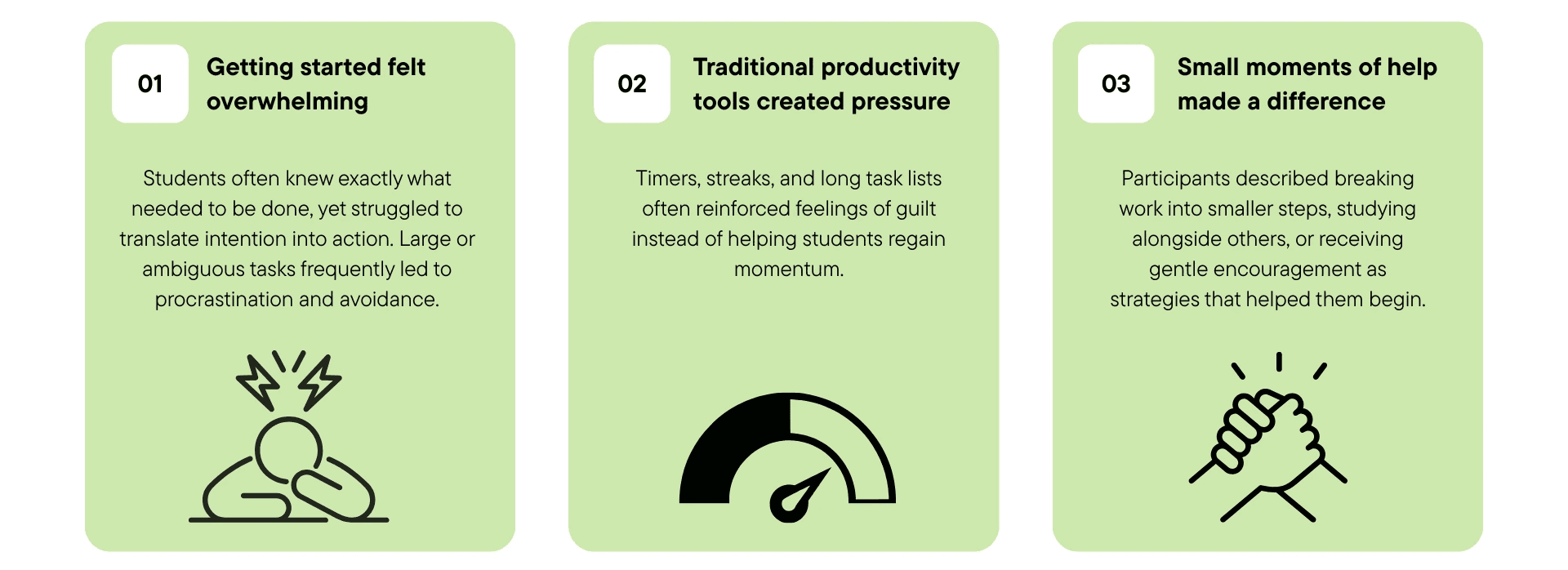
The pull towards the body-doubling technique
Many relied on body doubling—working alongside another person—to create the accountability needed to begin, but coordinating schedules with friends was often impractical. Once they started, they described staying engaged through small wins and positive feedback rather than strict discipline.
Together, these insights pointed toward designing a companion that could provide both the initial spark to begin and the ongoing support to maintain momentum.
Ideation
Translating research into design
Our brainstorming sessions eventually converged into a single design direction: an AI-powered study companion that combines task breakdown, virtual body doubling, and playful motivation into one cohesive experience. I worked on stringing all these features together in a intuitive flow.
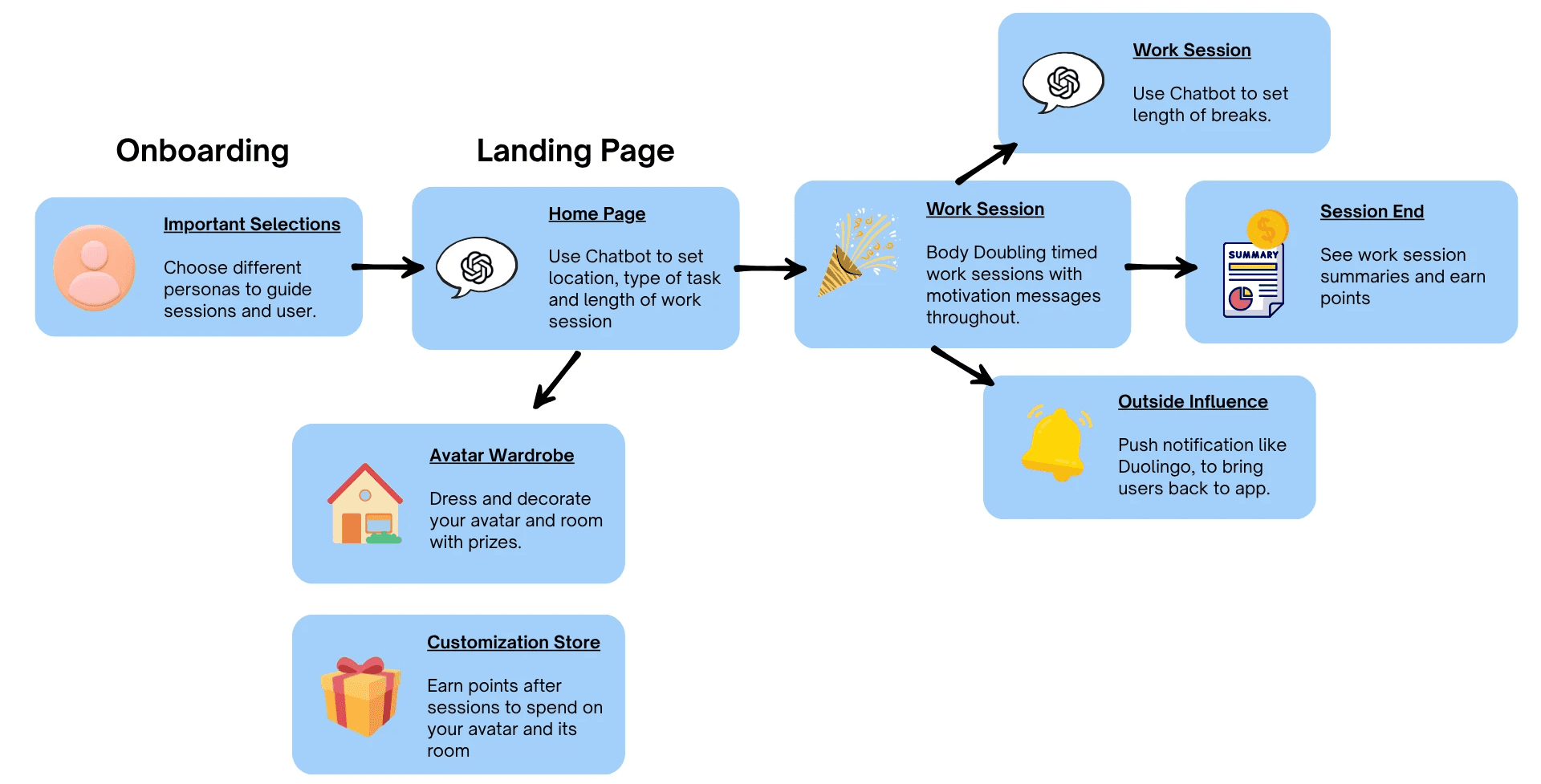
User flow through the features from beginning to end
AI Companion Personality
Research showed that support looks different for everyone. Some students wanted gentle encouragement, while others responded better to direct accountability or playful energy. This is the reason why onboarding was the most important to figure out in the early stage. To reflect these differences, we invited users to choose between three companion personalities—Gentle, Sassy, and Energetic—before sharing additional preferences that further shaped their AI companion.

Green - Energetic, Red - Sassy, Blue - Supportive
The Soul Of This Project: this balance of user choice and AI personalization helped create a study buddy that felt intentional rather than generic.
First Prototype!

01 - Avatars, 02 - Onboarding, 03 - Landing, 04 - Notification, 05 - Session, 06 - Rewards
Designing a companion, not just an assistant
Our first prototype proved the concept: an AI companion could guide students through study sessions and support task initiation. Functionally, it worked but the experience still felt transactional and made me question whether users would actually want to return to it day after day.
This shifted our focus from functionality to relationship. Rather than asking What should the AI do?, we began asking
Who should the AI be?
With extensive user research, I led explorations on how visual design, personality, and emotional expression could transform the companion from a generic assistant into someone users genuinely looked forward to studying alongside.
Designs
Bringing the companion to life
Takeaways on visual identity
I experimented with different avatar styles to understand what made a study companion feel approachable without becoming distracting. Inspired by the warmth of virtual pets and cozy games, I explored expressive characters, gestures and environments that could communicate encouragement, celebrate progress, and provide gentle accountability throughout each study session.
New avatar designs , their unique gestures, and costumes

New environments for desk work and chores

New interface assets for session summary and progress bar
Final Screens
These explorations ultimately shaped a companion that felt less like another productivity tool and more like an encouraging study partner—one users could build a relationship with over time.

Lessons
User research is the foundation

Throughout this process, our design would be just another task management app if not for our extensive research on how this will specifically help people with ADHD, a very focused and specific group of users and problem space. Additionally, user research was also essential in understanding and then even building a solution for a condition that none of us had. The research that we did allowed us to better empathize with users and receive better insights.
The design process does not have to be linear
For the second prototype after the user survey and feedback, we realized that our original design still could benefit from a lot of improvements. While this was frustrating because we thought we were done, we were determined. This is why we extended this project build timeline past the quarter and into summer.
