Caltrain
2024
Turning train rides into opportunities for connection.
Product Designer on a four-person team partnering with Caltrain, structured like 10 week design sprint

Overview
Helping commuters connect beyond the journey
Caltrain challenged our team to imagine new ways of increasing rider engagement after the pandemic. Rather than focusing on transportation logistics, we uncovered an opportunity to address the isolation many commuters experienced.

The result was CalCompanions, a social platform that helped riders connect through shared interests, local events, and recurring commutes. Beyond a "social platform" though, our goal was:
Designing for connection in a place where people rarely expect it.
Problem
Rethinking the daily commute
One night of observation showed us that many riders, commuting is a passive experience: headphones on, eyes forward, and little interaction with the people around them. While Caltrain efficiently moves people from one destination to another, it leaves an opportunity untouched: the chance to foster meaningful connections among commuters who often share the same routes every day.

The challenge became designing a social experience that felt natural, respected personal boundaries, and fit seamlessly into existing commuting habits.
Research
Understanding commuters
To better understand the commuting experience, we interviewed over 50 Caltrain riders across multiple stations, observing their routines and uncovering how they navigated daily travel. Rather than asking how to make transit faster, we focused on understanding what made commuting feel meaningful or isolating. This is what we found:

From this round of interviews and with the lowering sales trend in mind, we came with solid goals and questions on how we can design on the moments that could naturally spark conversation and community:
How Might We design an experience that enables passengers to look forward to their travels using Caltrain?
How Might We facilitate a space that comfortably and safely invites sociability amongst everyday commuters?
Ideation
Narrowing initial ideas to connect commuters
With a better understanding of commuters' needs, we explored multiple ways to encourage interaction without disrupting the rhythm of daily travel. At the brainstorming table we were going back and forth between 4 different ideas and directions. After weighing the pros and cons of each idea, we aligned on an idea that could be intuitively and scalable
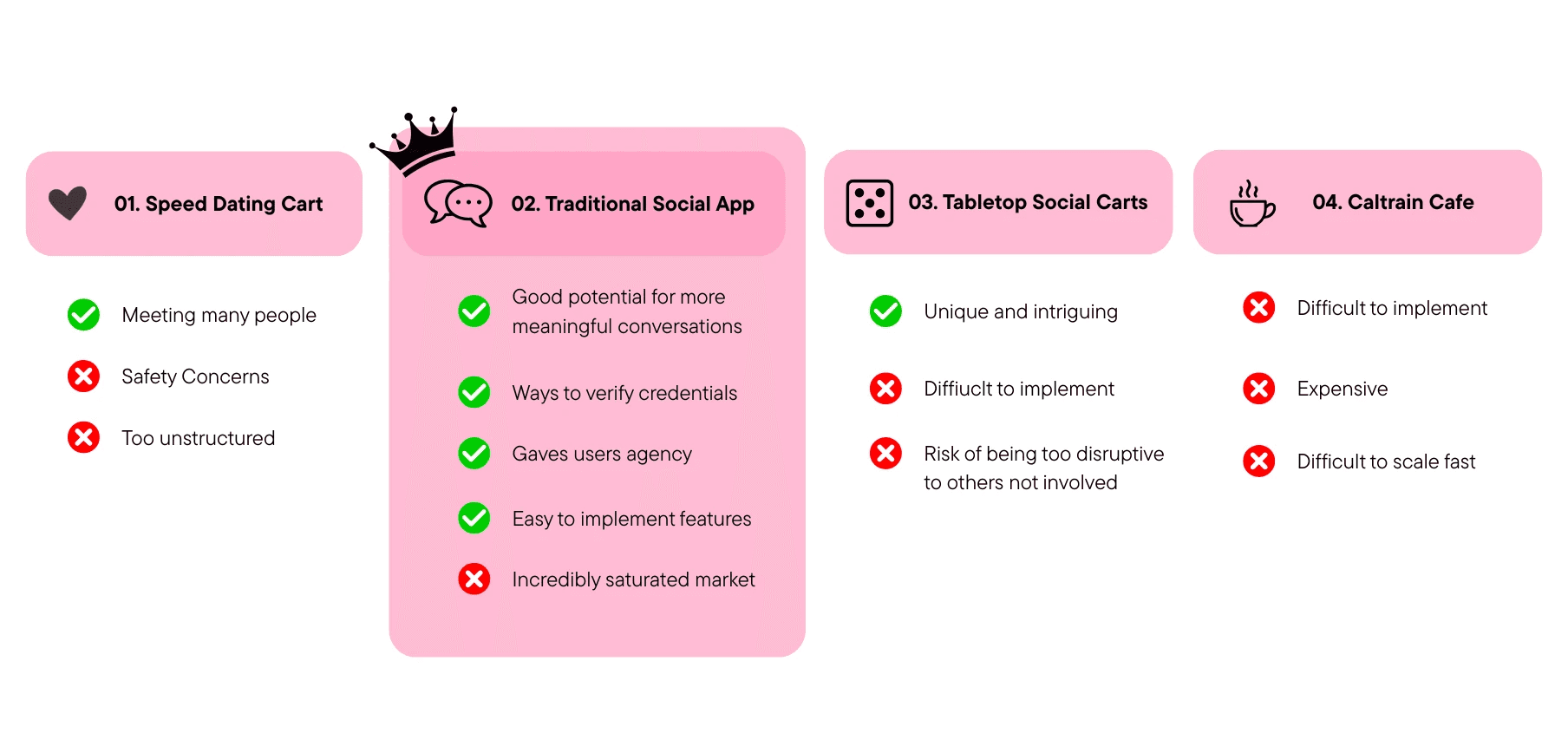
A matchmaking choose-your-own-adventure commute experience
Is this like tinder, hinge, or bumble — all social or dating apps that match people? At first glance, it might seem that way but the goal wasn't to build another awkward matching app. We envisioned something where matched riders could decide how they wanted to experience their journey, from discovering local events to meeting other people with shared interests.
My challenge then became identifying the features that would make these interactions feel natural, meaningful, and optional.

Initial Sketches
Giving the complexity of the task, I broke all these features down in initial sketches and paper-fidelity wire frames. Using this helped to visualize each design when I started building on Figma.

Exploration and Deals Dashboard
We iterated on the exploration page to balance two competing goals:
Helping users discover nearby activities while making it easy to scan and compare options.
Each iteration explored different levels of information density, filtering, and content hierarchy before converging on a more streamlined browsing experience.

01 & 02: A combination chosen
02 - Chosen

Design
The final experience
The final experience transformed the daily commute into a series of optional social moments. Rather than encouraging conversation for its own sake, CalCompanions helped riders discover people, places, and events that naturally fit into their journey—making connection feel intentional instead of intrusive.

Outcome
Lessons
Task Decomposition
This was an extremely complex topic for my team and I to solve, especially when the root of the problem we recognized was a social problem for the Caltrain (there's no quick fix). Given a complex topic, we did extensive research (desk, user, and market) to create a solution that might make an impact and increase ridership on the Caltrain. We needed to break down each research phase and design phase to be able to justify our solution comprehensively.
Understanding business goals in product development
This ensures that product decisions support key business goals, such as revenue growth, market expansion, or brand positioning. It also helps balance user needs with business sustainability.
Figma Mastery and Design Ownership
Taking ownership of the project pushed me to strengthen my skills in Figma, from wire-framing to prototyping, and gain confidence in making design decisions.,
