Designing a gentle AI guide for untangling overthinking
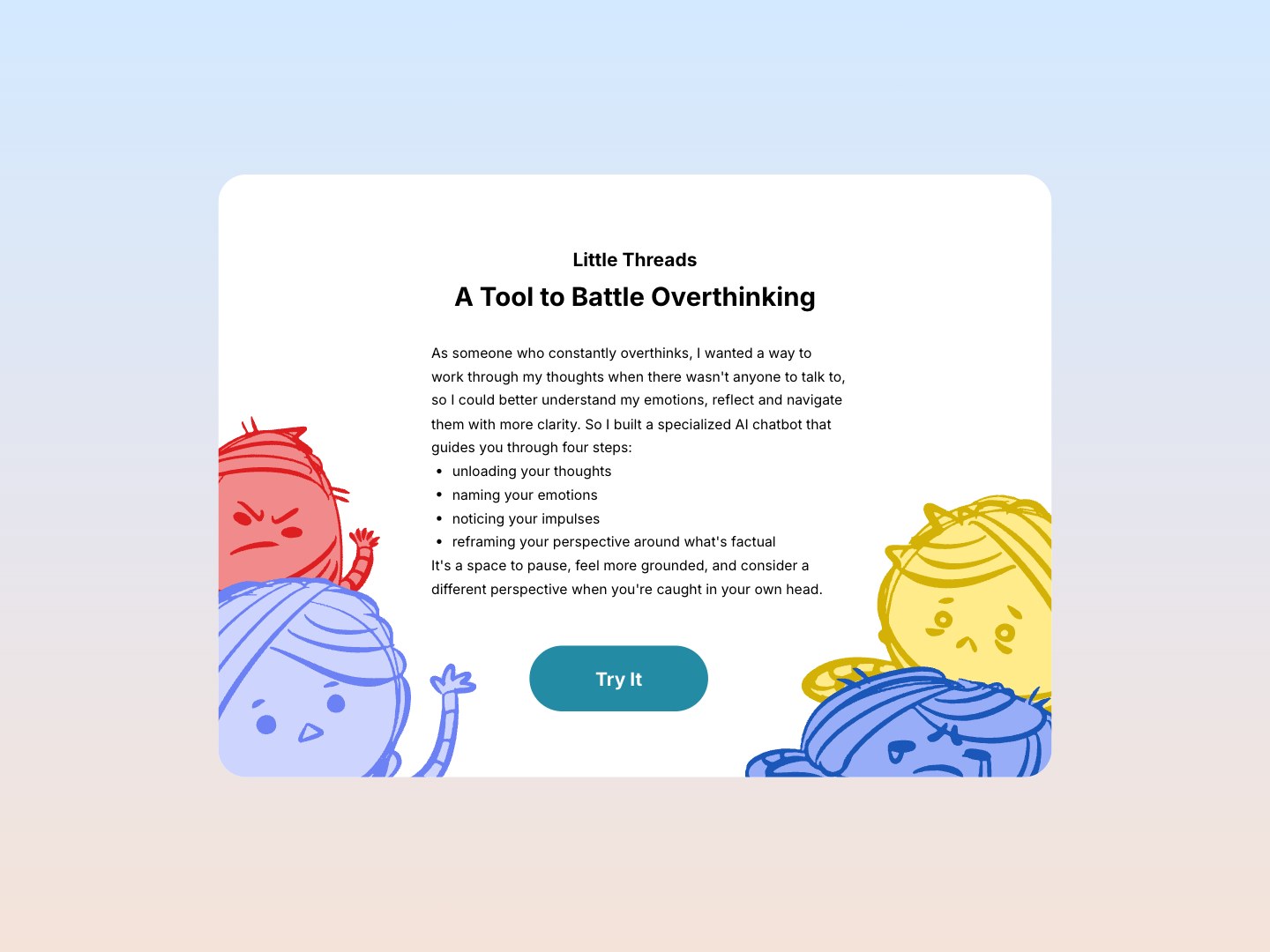
I designed and built Little Threads end to end: a calm web app where someone who's overthinking writes what's on their mind, and an AI guide walks them through five steps to separate what they're afraid of from what's actually true.
- Role
- Product Designer & Developer
- Timeline
- Oct 2026
- Team
- Solo
- Platform
- Web App
Overview
A little space to untangle your thoughts
As someone who constantly overthinks, and after already trying a lot of options, I wanted to take it into my own hands and build a way to work through my thoughts when there wasn't anyone to talk to. Other techniques, like journaling apps, felt overwhelming because they only hand you a blank page. Regular chatbots hand you a wall of generic advice, and generally shouldn't be used as a therapist. Neither helps you slow down and see the spiral for what it is.
Little Threads is a specialized AI guide that walks you through five steps to combat overthinking and understand your thoughts: Thought → Feelings → Impulse → Truth → Insight. I built this tool to create a space where it's easier to pause, feel more grounded, and consider a different perspective when you're caught up in your own head.
Problem
Overthinking turns a small moment into a whole story
I think we've all been there. A text goes unanswered and, within an hour, something feels tense. A wave of anxiety washes over you, and suddenly you're replaying every interaction before it in your head. Soon the narrative concludes, so easily, with "she's sick of me"... even before you have any evidence.
For many people, overthinking blends facts, fears and assumptions into one tangled knot, and the longer it spins, the more real it feels. As a person who loses sleep over this, I long to find a way to easily understand my emotions and thoughts so that I can overcome this and be a less anxious thinker.
How might we help someone separate what they're afraid of from what's actually true, gently and on their own, in the moment it's happening?
Research
What actually helps someone out of a spiral
Where existing tools fall short
- A blank journal lets you write the spiral down, but it doesn't help you step outside it.
- A general AI chatbot jumps straight to advice or reassurance, which can feel hollow, or quietly agree with the worst-case story.
- Talking to a friend helps most, but isn't always available at 1am.
Insights that shaped the design
- Naming it helps. Putting a feeling into words takes some of its power away, so emotions needed their own step instead of being implied.
- Facts and fears need to be pulled apart. The turning point is noticing the gap between what you think and what you actually know.
- People need to find the truth themselves. Being told "you're overthinking" doesn't land; reaching the conclusion yourself does.
- Safety can't be an afterthought. Anyone writing about a hard moment could be in real distress.
Ideation
Turning a messy spiral into five calm steps
I structured the experience as a guided path rather than an open chat, so the AI never takes over the conversation. Each step has one job:
Thought
Unload everything, however messy. Each key idea lands on its own card, in your own words.
Feelings
Name the emotions underneath, from five families, up to five.
Impulse
Notice what you feel pulled to do right now.
Truth
Write what's objectively true about your top three thoughts. The guide only gives hints.
Insight
Validation that brings it together, then advice, a thinking pattern, or an open chat.
Designing the guide's personality
The guide is defined in a single prompt I wrote and iterated on. I wanted it to sound like a warm, grounded friend who is also honest:
- Specific, not generic. It refers to the actual people and details someone shared ("Maya", "last week") instead of "that sounds hard."
- Validates feelings without confirming fears. It never says a worry is definitely wrong, and never agrees with a distorted conclusion either.
- Keeps their voice. Thought cards are cleaned up but never softened: "she's prob sick of me" stays "She's probably sick of me."
- Not a therapist. No diagnoses, no clinical jargon, no lecturing.
Designs
Walking through a reflection
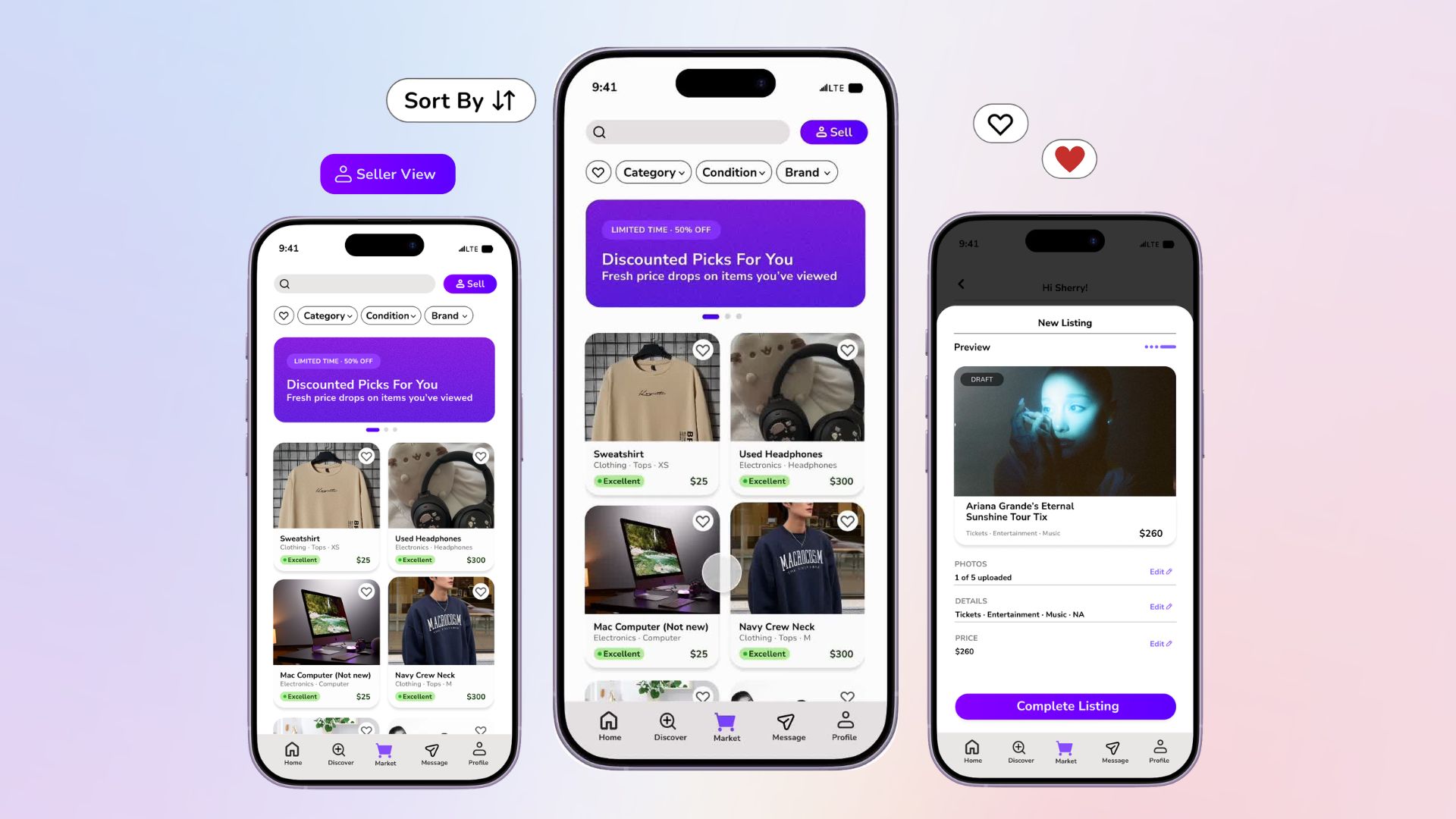
Every screen keeps the person's own words at the center, with yarn characters giving each emotion a soft, non-clinical face.
Home
One open question and a place to start typing, or speaking with voice input.
Thought
The messy entry becomes separate, editable cards in the person's own voice.
Feelings
Five emotion families, each with its own yarn character, to name what's underneath.
Impulse
Common urges to recognize, or the option to say it in your own words.
Truth
'What you said' sits beside 'What is objectively true', written by the person, not the AI.
Insight
Validation that brings it all together, then the person chooses what they need next.
Designing for safety and privacy
Because people may write about hard moments, safety was built into every response:
- Two layers of crisis detection. The AI flags signs of danger, and a keyword check runs as a backstop. Either way, a card with the 988 Suicide & Crisis Lifeline and Crisis Text Line appears, even if someone has hit a usage limit.
- Nothing stored on a server. "Save Progress" keeps a reflection only in that person's own browser.
- Honest framing. Little Threads is a reflection tool, not therapy or a crisis service, and says so.
Lessons
Designing for an AI that has to be gentle
The prompt is part of the design
How the guide talks matters as much as how the screens look. Writing and testing the guide's instructions, like keeping someone's exact words and never confirming a worst-case story, was interaction design, just in a different medium.
Structure is a kindness
Giving each step one small job made a heavy moment feel manageable. Constraints like "pick up to five feelings" or "three thoughts to check" kept people moving instead of spiraling further.
Building it myself changed my decisions
Taking the design from Figma to a working app meant designing for real edge cases: long rambling entries, usage limits, and what happens when someone is in danger.